Secret Night Time World of Wildlife
The joys of using a wildlife trail camera seem obvious. You can get a privileged insight into a secret night time world of wildlife in your garden – and you can record wildlife dramas while you’re tucked up in bed.
Tiddly Poops
My neighbour had bats – no doubt about it. At first, when I spotted tiny poops on her dustbin top, I thought she must have mice. Then I saw tiddly poops on the sills and on the windows. Well, it didn’t take a genious to work out that mice don’t relieve themselves on the outside of a bedroom window.
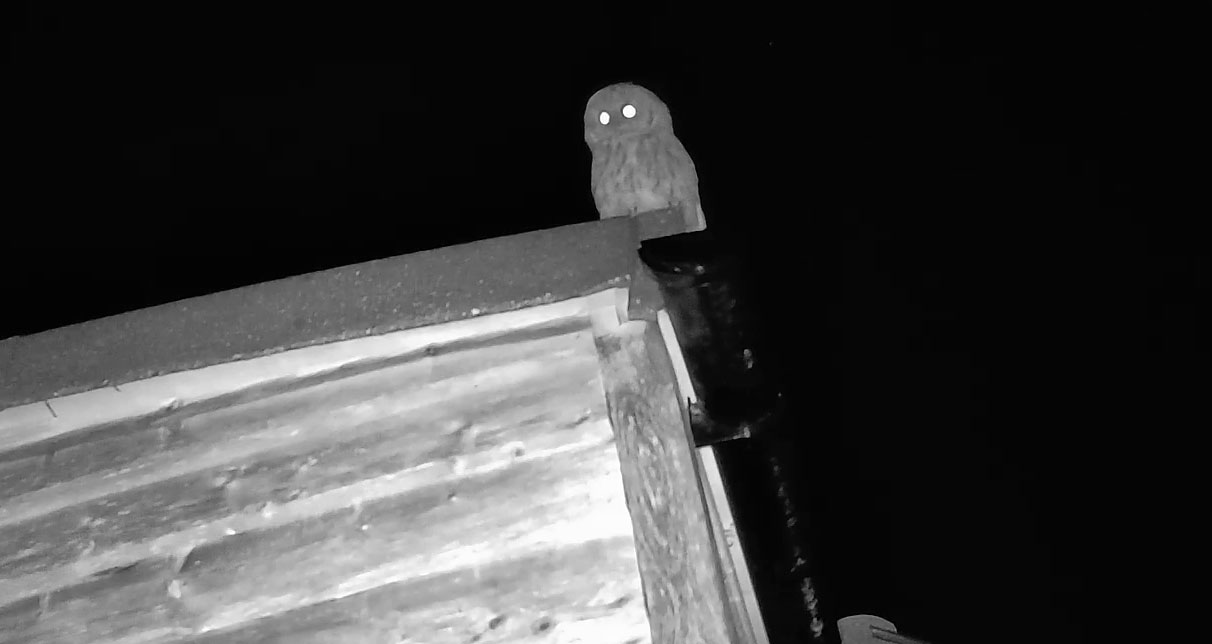
Click the image to see the tawny owl getting mobbed by bats as it perches above a bat maternity roost. Wildlife trail camera video by Philip Dunn.
In rural Shropshire we often see the occasional bat feeding around the house at dusk, but we’re talking about enough bat crap here to indicate a bat metropolis. Minute and crumbly pellets of poo. They were everywhere.
Maternity Roost
Time to investigate. So, next evening I staked out the area at the back of the house. Sure enough, just as dusk fell, the bats appeared. Each one dropped out of a little gap under the eaves. They fell out like parachutists, one after the other, shooting off in different directions. They knew exactly where they were going.
Some zig-zagged off up the garden; some flew directly to the woodland across the road, others seemed content to circle the house. Next evening was the same. I counted 172 bats parachuting out of that gap in the eaves. I could hardly believe my eyes. Time to set up my Wildlife Trail Camera.
A little research indicated this was almost certainly a bat ‘Maternity Roost’. A summer roost where pregnant females give birth and raise their young. I can’t be sure, but I think these were pipistrelle bats. These little critters are capable of eating 3000 insects every night. I suppose that’s why they poo so much.
Surprise
In June or July, a female will give birth to one offspring that will be fed solely on mother’s milk for 3-4 weeks. After 4 weeks the young are able to fly, and at six weeks they can forage for themselves. Although they are most certainly not blind, pipestrelle bats don’t have great eyesight and locate their food on the wing using echo-location.
I set up the wildlife trail camera on a heavy old Benbow tripod. I wedged this into the gutter of a lower roof and aimed the camera at the underside of the eaves where the bats appeared each night. What a surprise I got next morning when I reviewed the night’s videos.
Hungry Owl
The bats were active all night until dawn, but around 3.20am a tawny owl appeared and perched on the corner of the roof just above the bat hole. He watched hungrily as the bats circled. They were oblviously too wary to risk going back to feed their young while the owl was there, but they certainly made life unpleasant for him. I think one actually hit the owl on the head. The owl did the wise thing, gave up after 15 minutes or so and flew off.
What a lovely surprise, and proof that with a wildlife trail camera you really can see what’s going on while you are tucked up in bed.